
What is a named virtual IBAN?
Trillioni Pay team · Published · Updated · Verified · 10 min read
Drafted with AI from primary sources, checked against them and reviewed before publication. How we write articles
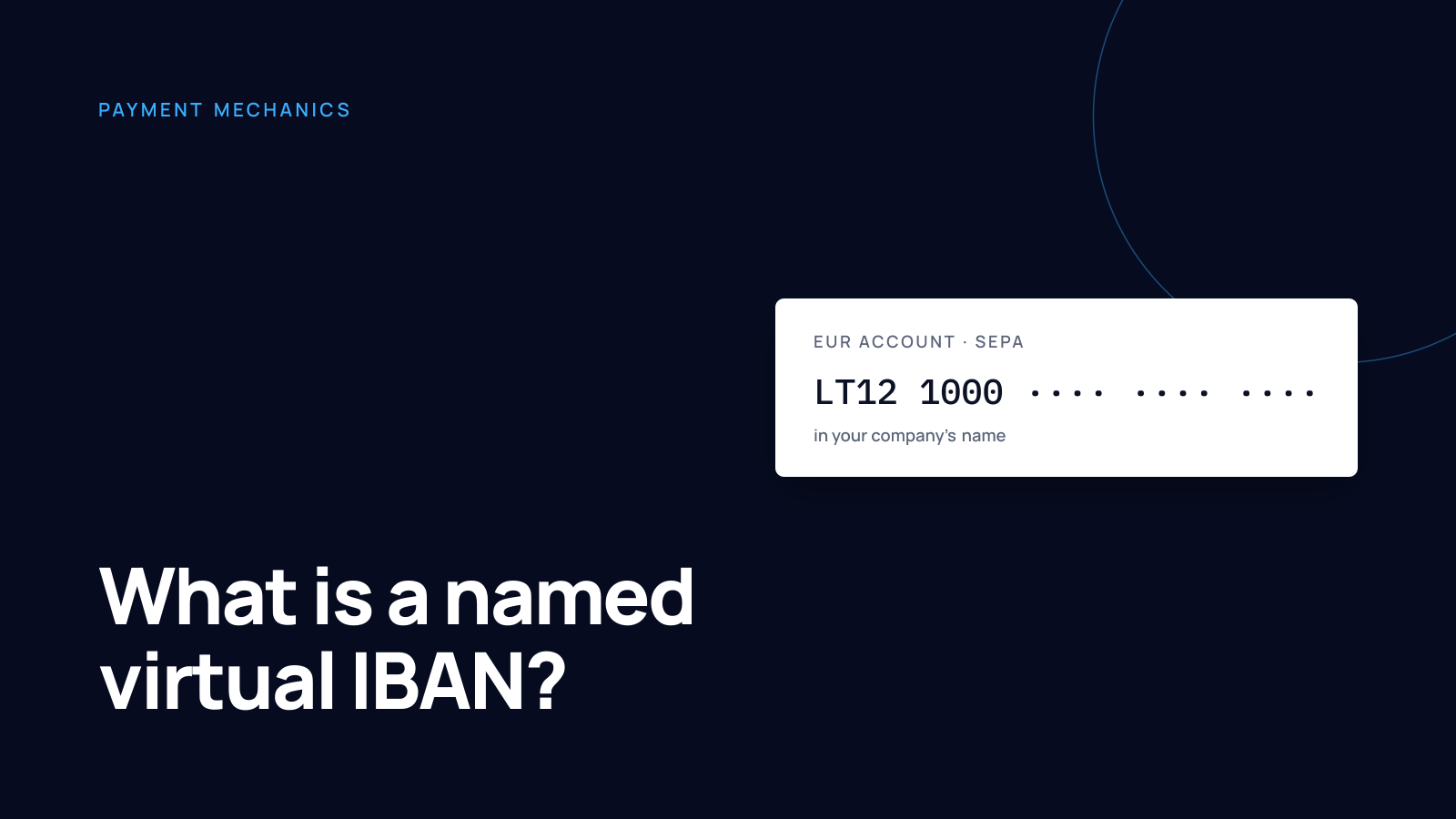
A virtual IBAN in your own company name changes what your European customer sees when they pay you. Here is the mechanism, and the limits.
On this page
"Virtual IBAN" is an unhelpful name for a useful thing. The word virtual suggests something simulated, which puts finance directors on guard, and it obscures the one property that decides whether the arrangement is worth having: whose name is on it.
This article explains the mechanism, the distinction that matters, and the four things a virtual IBAN does not give you.
Key takeaways
- What is an IBAN?
- A standardised identifier for a payment account, defined by ISO 13616. It identifies an account. It is not the account.
- What makes one virtual?
- It routes payments to an account held under a different IBAN, rather than being the account's own primary identifier.
- What does named mean?
- The account details are registered to your company's legal name, so that is the name your payer's bank sees.
- Why does the name matter now?
- Since 9 October 2025, euro-area banks must show payers whether the beneficiary name matches the account. A mismatch is visible before the payment is sent.
- Does it make my company European?
- No. It gives no licence, no legal establishment and no change of tax residence.
- Is it a bank account?
- Not when it is issued by a payment or electronic money institution. It is a payment account, with different protections.
What an IBAN is
IBAN stands for International Bank Account Number. It is a format defined by ISO 13616 that combines a country code, two check digits and a domestic account identifier into a single string that can be validated before a payment is sent. A Lithuanian IBAN is 20 characters and begins LT. An Egyptian IBAN is 29 characters and begins EG.
The check digits are the reason it exists. They let a sending system catch a typo before the money moves, which the older practice of quoting a bank code and an account number separately could not do.
An IBAN is an identifier. The account is the thing the identifier points to, and the two are separable. That separability is the whole of what "virtual" means.
What makes an IBAN virtual
The European Banking Authority examined this in its report on virtual IBANs, EBA/Rep/2024/08, published in May 2024. It uses the definition from the EU Anti-Money Laundering Regulation, then still forthcoming: a virtual IBAN is "an identifier causing payments to be redirected to a payment account identified by an IBAN different from that identifier" (European Banking Authority, checked September 2026).
In plainer terms: a payment sent to the virtual IBAN arrives in an underlying account whose own IBAN is a different string. The virtual identifier is a routing instruction and a label.
That is the entire mechanism, and it is unremarkable. Banks have used the same technique for decades to give corporate treasuries a separate identifier per subsidiary or per customer, sitting over one physical account. The EBA report lists group treasury management among the use cases it identified.
What matters commercially is not that the identifier is virtual. It is what the identifier is registered to.
Named against pooled: the distinction that decides everything
There are two ways a provider can give a business euro account details, and they are often described in the same marketing language while behaving very differently.
| Named account details | Pooled account with a reference | |
|---|---|---|
| Registered name | Your company's legal name | The provider's name |
| What the payer types | Your company name, matching the account | The provider's name, plus a reference code you must supply |
| What the payer's bank shows them | A name match | A name mismatch, or an unfamiliar company |
| If the reference is omitted | The payment still arrives | The payment may be unallocated or returned |
| Reconciliation | By account | By reference code, manually |
| How it reads to your customer's finance team | An ordinary supplier payment | A payment to a third party they have never heard of |
The second arrangement is common, cheaper to operate and often sold as equivalent. It is not equivalent, and the gap widened in October 2025.
Why Verification of Payee changed the stakes
Under the EU Instant Payments Regulation, payment service providers in the euro area have been required since 9 October 2025 to offer a free Verification of Payee service. Before a payer confirms a transfer, their bank checks the beneficiary name they typed against the name registered to the account and shows them a match, a close match, or a mismatch. Providers in non-euro Member States follow by 9 July 2027 (European Central Bank, checked September 2026).
Payers still have discretion to proceed after a warning. Many will not. A mismatch warning on a screen that also says "this may be a scam" is the point at which an accounts payable clerk stops and asks their manager, and a manager who has read anything about invoice redirection fraud will call you.
So a pooled arrangement that worked quietly in 2024 now produces a visible red flag on every payment, and named details produce a clean match. That is the practical case, and it has nothing to do with technology.
What a named virtual IBAN does for a business outside Europe
For an Egyptian, Moroccan, Algerian or Gulf company selling into the European Union, four things change.
Your customer makes a domestic payment. A euro transfer to a euro IBAN inside the SEPA area is an ordinary transfer for them. No correspondent banks, no international transfer form, no charge option to negotiate. The reasons an account outside the SEPA area cannot receive one are set out in the SEPA explainer.
Nothing is deducted in transit. Within SEPA the amount sent is the amount credited. The deductions described in the SWIFT article are a property of the correspondent chain, and that chain is not in the path.
Their procurement system accepts it. Some European buyers' systems are configured to expect a euro IBAN, and some reject non-EU beneficiaries outright. Requiring an account in a particular Member State is prohibited under Article 9 of Regulation (EU) 260/2012, sometimes called IBAN discrimination. That prohibition is frequently ignored in practice, and a euro IBAN removes the argument rather than winning it.
Reconciliation gets easier. Payments arrive against your own account details with the payer's reference intact, rather than into a shared account you have to unpick.
What it does not do
The EBA's report is candid about the risks in these arrangements, and a provider that will not repeat them is not one to trust with your receivables.
It does not give you a European licence or legal establishment. Your company remains incorporated where it is incorporated, tax resident where it is tax resident, and subject to its own regulator. TrillioniPay states this on the account itself, not in a footnote.
It does not make the issuer a bank. When account details are issued by a payment institution or an electronic money institution, funds are safeguarded rather than deposited. There is no deposit guarantee scheme covering the balance. The EBA specifically flagged customer confusion about deposit protection as one of the problems with how virtual IBANs are marketed.
It does not hide who you are. The EBA's central AML concern is exactly the opposite risk: that the institution issuing the identifier may lack visibility of the end user. A properly run arrangement is one where the issuer knows precisely who you are, which is why the onboarding is thorough. If a provider offers you euro account details without asking who owns your company, the absence of friction is the warning.
It does not change your complaint route. If something goes wrong, the entity you complain to is the one you contracted with. The EBA flagged inadequate disclosure of complaint procedures as a recurring failing. TrillioniPay publishes its complaints process, including acknowledgement and resolution timeframes and how to escalate.
Why TrillioniPay says "named account details" rather than "virtual IBAN"
Two reasons, and neither is marketing.
The word virtual understates what the customer receives. Account details registered to your own company name, reachable by SEPA, are not a simulation of anything.
And the industry uses "virtual IBAN" for both of the arrangements in the table above. A term that covers both the thing that produces a name match and the thing that produces a name mismatch is not a term worth using to describe either.
The mechanism is what the EBA describes. The label on this site is chosen to say which version of it you are getting.
What TrillioniPay offers
TrillioniPay is a Canadian FINTRAC-registered money services business. It is not a bank. Account and payment infrastructure is provided through regulated financial partners.
TrillioniPay provides named euro account details, issued through a regulated financial partner in Lithuania, an EU Member State inside the SEPA area. The details carry the customer's own company name, are reachable by SEPA credit transfer, and can be given to European customers as ordinary payment details.
Named account details are for euro: the EUR IBAN is issued in your company's own name, within 48 hours of approval. Payments in other currencies are received through a collection account, which identifies your payment by its reference rather than by a named IBAN.
The account details do not provide a European licence or legal establishment. TrillioniPay remains the customer-facing Canadian MSB. Availability depends on eligibility, KYC/KYB and compliance approval, and on partner coverage at the time your account opens.
Frequently asked questions
Is a virtual IBAN a real IBAN?
Yes. It is a valid IBAN under ISO 13616, it validates in any banking system, and payments sent to it settle normally. What distinguishes it is that it routes to an underlying account with a different IBAN.
Can my European customer tell it is virtual?
Not from the IBAN itself. What they see is the country code and the registered name. With named details, the name is yours and the country code is the issuing institution's.
Is this legal?
Yes. Virtual IBANs are used across the European payments industry, including by banks. The EBA's 2024 report addressed inconsistent supervision and disclosure across the EU, and recommended clarification rather than prohibition.
What happens to my money if the provider fails?
Client funds are safeguarded in segregated accounts separate from the provider's own funds. That is a different protection from deposit insurance, and the balance should not be treated as covered by a deposit guarantee scheme. The security article sets out the arrangement.
Can I get account details in US dollars and pounds as well?
US dollar and pound sterling account details are planned for vetted customers after launch. They are not available yet. The euro IBAN is the first product.
My customer's bank showed a mismatch warning. What now?
Give them the exact registered legal name on your account details, character for character, for their supplier record. If the registered name is not your company's, the arrangement is pooled rather than named and the account type is what needs to change.
Sources
- European Banking Authority, Report on virtual IBANs, EBA/Rep/2024/08, May 2024: definition, use cases, AML/CFT and consumer protection findings, and recommendations. Checked September 2026.
- European Central Bank, Instant Payments Regulation: Verification of Payee obligations from 9 October 2025 in the euro area and 9 July 2027 elsewhere. Checked September 2026.
- Regulation (EU) 260/2012, Article 9, on payment accessibility and the prohibition on requiring an account in a particular Member State. Checked September 2026.
- ISO 13616, International Bank Account Number structure. Checked September 2026.
Further reading
- SEPA explained: what it covers, and why an Egyptian company cannot receive a SEPA transfer
- SWIFT explained: the only rail that reaches everywhere, and what that reach costs
- Glossary: IBAN, virtual IBAN, safeguarding
- Pillar: How a cross-border business payment actually works
Want to know whether your company qualifies? The eligibility checker tells you where you stand against published rules before you assemble any documents.
Trillioni Pay Inc. is a Canadian FINTRAC-registered money services business (C100000813). TrillioniPay is not a bank. Account and payment infrastructure is provided through regulated financial partners.
The account details do not provide a European licence or legal establishment. TrillioniPay remains the customer-facing Canadian MSB.
This is general information as at September 2026. It is not legal, tax or compliance advice. Rules change. Verify with the relevant authority or your own adviser.
Availability depends on eligibility, KYC/KYB and compliance approval, and on partner coverage at the time your account opens.
Sources
- 1.European Banking Authority, Report on virtual IBANs, EBA/Rep/2024/08, May 2024 · checked 25 September 2026
- 2.European Central Bank, Instant Payments Regulation: Verification of Payee obligations · checked 25 September 2026
- 3.Regulation (EU) No 260/2012, Article 9 · checked 25 September 2026
- 4.ISO 13616, International Bank Account Number structure · checked 25 September 2026
Last updated